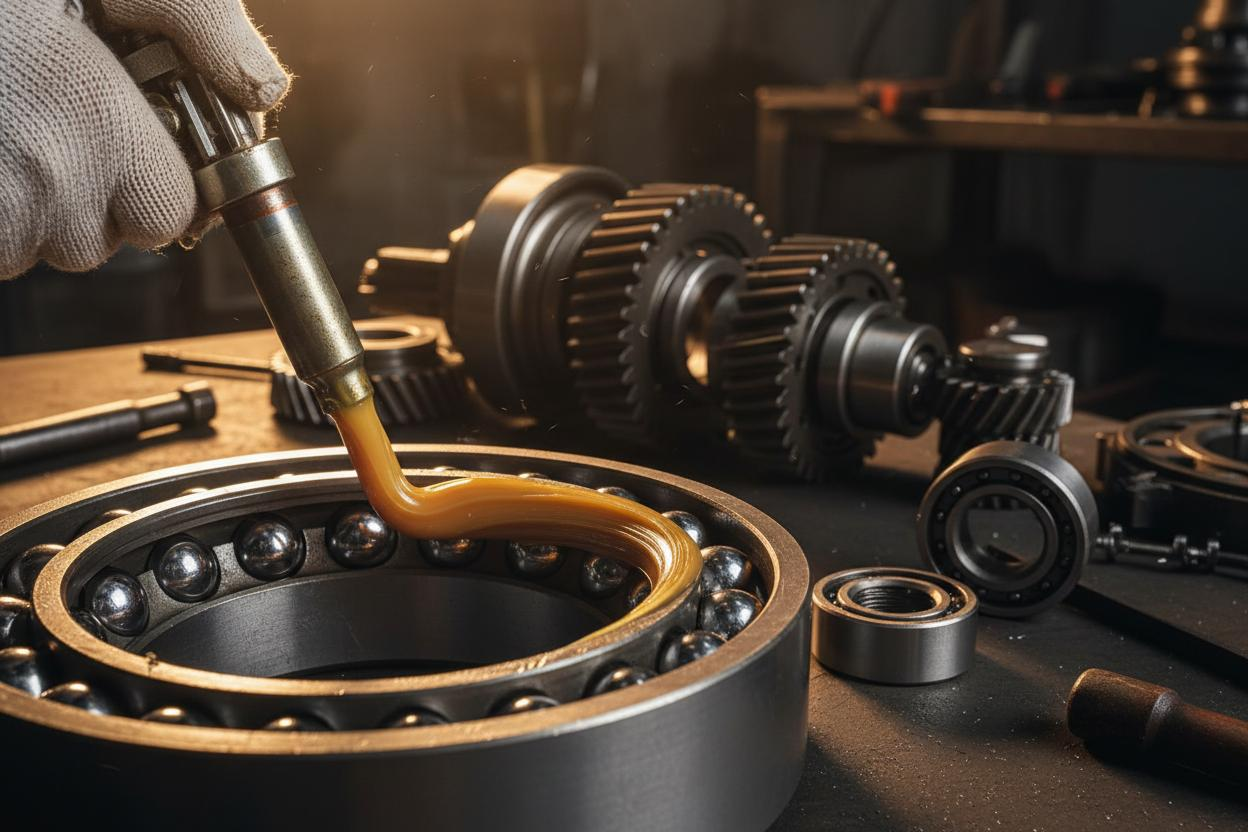

Best High Temperature Bearing Grease: How to Choose the Right One

Best High Temperature Bearing Grease: How to Choose the Right One
Bearings operating at elevated temperatures face demanding lubrication conditions. Heat can accelerate oxidation, reduce base oil viscosity, increase oil evaporation, and eventually shorten grease life. Choosing the best high temperature bearing grease therefore requires a careful evaluation of the complete operating environment rather than relying on a single specification.
A suitable high temperature bearing grease should maintain an adequate lubricating film, resist thermal and oxidation degradation, remain stable inside the bearing, and provide reliable protection against wear and corrosion.
But how do you choose the right grease for your application?
What Is High Temperature Bearing Grease?
High temperature bearing grease is formulated for bearing applications where operating temperatures are higher than those typically handled by conventional mineral-oil-based greases.
Depending on the formulation, high temperature greases may use synthetic base oils such as PAO, ester, or specialty fluids, together with lithium complex, polyurea, clay, or other thickener systems.
For example, synthetic base oils can offer better viscosity retention across a wide temperature range, while certain non-soap thickeners can provide strong high-temperature structural stability.
However, there is no single high temperature grease that is best for every bearing application. The correct product depends on the bearing's speed, load, temperature, environment, and lubrication method.
What Makes a Bearing Grease Suitable for High Temperatures?
Several characteristics should be considered when selecting high temperature bearing grease.
1. Base Oil Type
The base oil is one of the most important factors affecting grease performance.
At elevated temperatures, base oil viscosity decreases. If the viscosity becomes too low, the lubricant film may not provide adequate separation between the bearing's rolling elements and raceways.
Synthetic base oils can provide advantages over conventional mineral oils when a wide operating-temperature range or high-temperature performance is required.
For this reason, don't choose a high temperature grease simply because it has a high advertised temperature limit. Check the base oil type and viscosity at the relevant operating temperature.
2. Base Oil Viscosity
Base oil viscosity should match the bearing's speed and load conditions.
A grease with very high viscosity may generate excessive friction and heat at high speeds, while a grease with insufficient viscosity may not provide an adequate lubricating film under heavy loads.
SKF identifies base oil viscosity, NLGI consistency, thickener type, dropping point, and operating temperature range as important grease properties to evaluate when selecting bearing grease.
For high-temperature applications, the key question is not simply:
“What is the highest temperature this grease can withstand?”
Instead, ask:
“Does the base oil maintain sufficient viscosity and lubrication performance at my actual bearing operating temperature?”
3. Thickener Type
The thickener forms the structure that holds the base oil in the grease.
Common thickener systems include:
- Lithium complex
- Polyurea
- Calcium sulfonate complex
- Clay
- Other specialty non-soap thickeners
Different thickener systems provide different levels of thermal stability, mechanical stability, water resistance, and compatibility.
For example, some high-temperature greases use clay thickeners because they can provide strong structural stability at elevated temperatures. Mobiltemp SHC products combine PAO synthetic base fluids with an organo-clay thickener for high-temperature applications.
Does a Higher Dropping Point Mean a Better High Temperature Grease?
Not necessarily.
Dropping point is useful for identifying and comparing grease thickener systems, but it should not be treated as the maximum operating temperature of the grease.
A grease can have a very high dropping point while still having a lower practical bearing operating temperature because the base oil may oxidize, evaporate, or lose sufficient viscosity before the thickener reaches its dropping point.
ExxonMobil's technical guidance specifically notes that dropping point alone has limited significance for actual service performance. Bearing test results can provide a more realistic indication of continuous operating temperature.
Therefore, when comparing two high temperature bearing greases, look beyond the dropping point.
Consider:
Operating temperature + bearing test data + base oil viscosity + grease life
rather than relying on dropping point alone.
NLGI Grade: Which One Should You Choose?
NLGI grade describes grease consistency, or how firm the grease is.
For rolling bearings, NLGI 2 is a common consistency grade, while NLGI 1 and NLGI 3 may be preferred for specific applications. SKF notes that NLGI 1 can be useful for low-temperature or oscillating applications, while NLGI 3 can be suitable for large bearings, vertical shaft arrangements, higher ambient temperatures, or vibration.
A simplified comparison is:
| NLGI Grade | Typical Characteristics |
|---|---|
| NLGI 1 | Softer grease, better flow/pumpability |
| NLGI 2 | Common general-purpose bearing consistency |
| NLGI 3 | Firmer grease, useful for some high-temperature or vibration applications |
However, NLGI grade should not be selected based on temperature alone. Bearing design, lubrication method, speed, and application conditions must also be considered.
How High Temperature Affects Bearing Grease Life
Temperature has a significant impact on grease life.
As temperature increases, oxidation and evaporation can accelerate. At the same time, base oil viscosity decreases, which can reduce the thickness of the lubricating film.
This means that two greases with similar dropping points may have significantly different practical service lives.
For example, Mobil's technical comparison shows that bearing-test-based temperature limits can differ substantially from limits suggested by dropping point alone.
Therefore, when selecting the best high temperature bearing grease, grease life data under relevant test conditions can be more useful than a simple dropping point comparison.
Choosing Grease for High-Speed Bearings
High-speed bearings require special attention.
A grease that is suitable for slow-moving, heavily loaded bearings may not be suitable for a high-speed spindle or electric motor bearing.
For high-speed applications, consider:
- Base oil viscosity
- Bearing speed
- DN value
- Friction and torque
- Heat generation
- Grease quantity
- Relubrication interval
- Bearing manufacturer recommendations
The goal is to provide sufficient lubrication without generating excessive frictional heat.
Choosing Grease for Heavy Loads and High Temperatures
High-temperature and heavy-load applications require a balance between thermal stability and load-carrying performance.
Applications may include:
- Steel mill bearings
- Kiln and oven bearings
- Conveyor bearings
- Electric motors
- Fans and blowers
- Textile machinery
- Industrial pumps
- High-temperature processing equipment
For heavy loads, the required base oil viscosity and additives should be considered together with the bearing's operating speed.
For example, some high-temperature greases are specifically formulated with higher-viscosity base oils for heavy-duty bearing applications.
High Temperature Grease for Electric Motor Bearings
Electric motor bearings have their own lubrication requirements.
A suitable grease should provide appropriate base oil viscosity, good oxidation resistance, and compatibility with the motor's bearing and seals.
For high-speed motor bearings, excessive grease quantity or an unsuitable high-viscosity grease can increase friction and operating temperature.
The motor manufacturer's lubricant recommendation should therefore be considered before selecting an alternative product.
When Should You Consider PFPE High Temperature Grease?
For extremely demanding environments, conventional mineral or synthetic hydrocarbon greases may not provide the required chemical or thermal stability.
PFPE grease can be considered for applications requiring exceptional resistance to aggressive chemicals, high temperatures, vacuum, or other severe conditions.
However, PFPE lubricants should not automatically be treated as a replacement for conventional grease. Compatibility with existing grease, seals, materials, and application conditions must be checked before switching lubricants.
For example, Mobil SHC PF 462 is a PFPE/PTFE grease designed for demanding high-temperature applications and is stated to be compatible with other PFPE/PTFE greases, but not typical mineral or synthetic greases.
How to Choose the Best High Temperature Bearing Grease
Before purchasing a high temperature bearing grease, collect the following information:
Application
What equipment and bearing are you lubricating?
Operating Temperature
What is the normal operating temperature, and what is the maximum temperature?
Bearing Speed
What is the bearing speed or DN value?
Load
Is the bearing lightly loaded, heavily loaded, or exposed to shock loads?
Environment
Is the bearing exposed to:
- Water?
- Dust?
- Chemicals?
- Steam?
- Vacuum?
- High humidity?
Lubrication Method
Will the grease be applied manually, through an automatic lubrication system, or during bearing assembly?
Existing Grease
What grease is currently being used?
This information helps determine the appropriate base oil, viscosity, thickener, NLGI grade, additives, and relubrication interval.
Best High Temperature Bearing Grease: A Practical Selection Checklist
When comparing different products, use this checklist:
1. Check the actual operating temperature
Don't rely only on the advertised maximum temperature.
2. Check base oil viscosity
Make sure the viscosity is appropriate for bearing speed and load.
3. Check thickener compatibility
Different thickener systems may not be compatible.
4. Check NLGI grade
Choose the consistency appropriate for the bearing and lubrication method.
5. Check grease life data
Look for relevant bearing or high-temperature life testing.
6. Consider water and contamination resistance
This is especially important for outdoor and industrial applications.
7. Check material compatibility
Verify compatibility with seals, plastics, and other materials.
8. Follow the bearing manufacturer's recommendation
A technically suitable grease still needs to be appropriate for the specific bearing.
Final Thoughts
The best high temperature bearing grease is not necessarily the product with the highest dropping point or the highest advertised temperature rating.
A better selection should consider the complete lubrication system, including base oil type, base oil viscosity, thickener, NLGI grade, bearing speed, load, operating temperature, environment, and grease life.
For moderately high-temperature bearing applications, synthetic PAO or other suitable synthetic formulations can provide a useful combination of thermal stability and lubrication performance. For extremely demanding conditions, specialty lubricants such as PFPE greases may be worth evaluating.
If you are unsure which grease is suitable for your application, provide the bearing model, operating temperature, speed, load, existing grease, and application equipment. A lubricant supplier can then help narrow down the appropriate product.
How to Choose Bearing Grease for High-Speed Applications