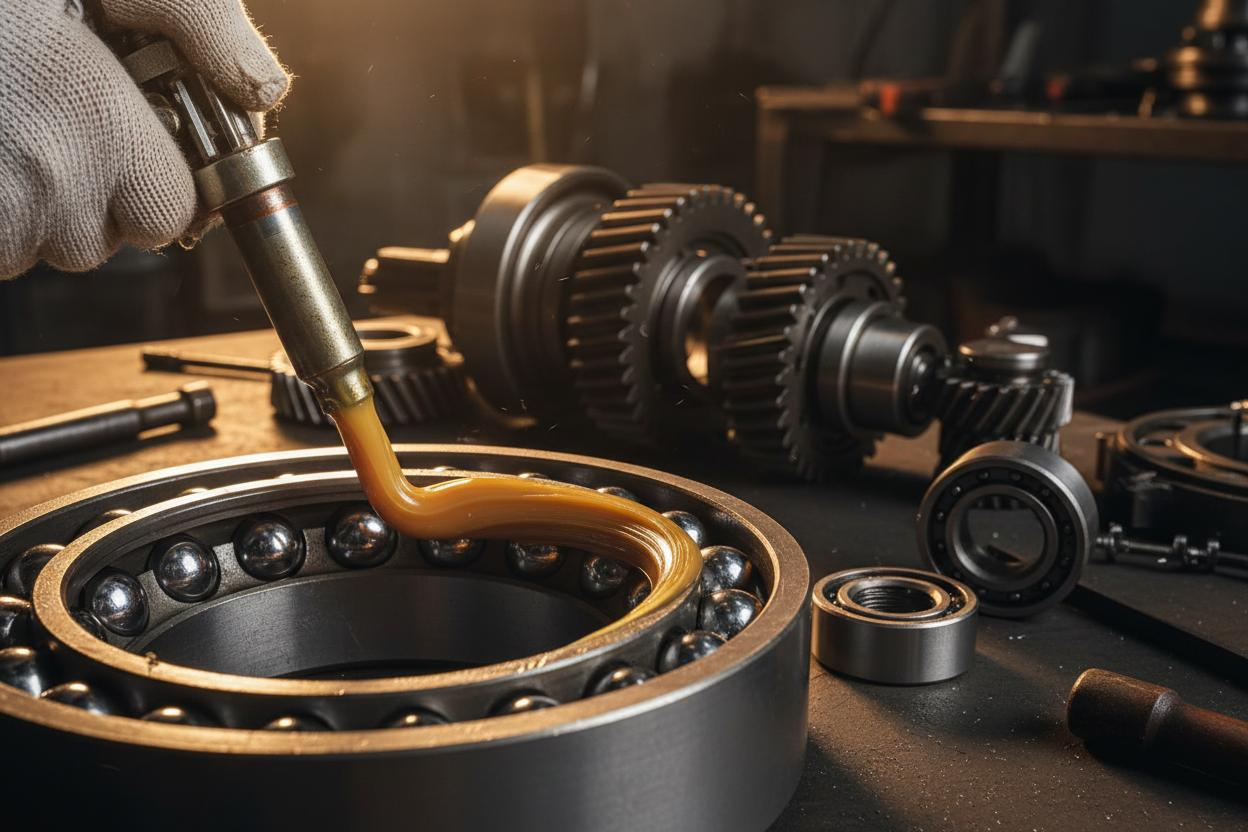

How to Choose Bearing Grease for High-Speed Applications

High-speed bearings operate under demanding conditions where friction, heat generation, lubricant distribution, and grease stability become critical. Choosing an unsuitable bearing grease can increase torque, operating temperature, lubricant degradation, and ultimately the risk of premature bearing failure.
This guide explains how to choose bearing grease for high-speed applications by evaluating the key operating parameters that influence grease performance. From calculating the bearing speed factor to selecting the appropriate base oil viscosity and NLGI grade, each factor plays an important role in achieving reliable lubrication.
What Makes High-Speed Bearing Grease Different?
A high-speed bearing grease must balance several competing requirements. The grease needs to provide sufficient lubrication while minimizing friction and heat generation. Excessively high-viscosity base oils can increase friction at high rotational speeds, while an unsuitable viscosity may fail to provide an adequate lubricating film. SKF notes that high-speed conditions are associated with high n·dm values, and lubricant selection should account for the relationship between operating speed and base-oil viscosity.
High-speed bearing grease typically requires:
- Low to moderate friction and torque
- Appropriate base oil viscosity
- Good mechanical and shear stability
- Excellent resistance to oxidation
- Reliable temperature performance
- Good oil separation characteristics
- Compatibility with bearing materials and seals
- Appropriate grease quantity
1. Calculate the Bearing Speed Factor
One of the first parameters to consider is the speed factor (n·dm).
The commonly used calculation is:
n·dm = rotational speed × mean bearing diameter
where:
- n = bearing speed in revolutions per minute (rpm)
- dm = mean bearing diameter, approximately
(d + D) / 2 - d = bearing bore diameter
- D = bearing outside diameter
For example, a bearing operating at 12,000 rpm with a mean diameter of 50 mm has an n·dm value of 600,000.
This value provides a useful starting point for determining whether a conventional grease is suitable or whether a specialized high-speed bearing grease should be considered. SKF's selection charts classify bearing speed using n·dm, with the applicable range depending on bearing type.
2. Select the Right Base Oil Viscosity
Base oil viscosity is one of the most important factors in high-speed grease selection.
A high-viscosity grease is not automatically better for a bearing. At high rotational speeds, excessive base oil viscosity can increase friction and heat generation. Conversely, a viscosity that is too low may provide insufficient film thickness under the actual load and temperature conditions.
SKF explains that high-viscosity greases can increase bearing friction and heat, while the required viscosity should be evaluated according to operating conditions.
For high-speed applications, synthetic base oils such as:
- PAO
- Ester
- PFPE
- Synthetic hydrocarbon-based oils
may be considered depending on temperature, speed, load, material compatibility, and required service life.
3. Choose the Appropriate NLGI Grade
The NLGI grade describes grease consistency, but it should not be used alone to determine whether a grease is suitable for high-speed bearings.
For many high-speed bearing applications, relatively soft greases such as NLGI 1 or NLGI 2 may be considered, depending on bearing design and lubrication method.
However, the correct choice depends on the complete grease formulation. Two NLGI 2 greases can have very different high-speed performance because their base oils, thickeners, additives, and rheological properties may differ significantly.
Therefore, instead of asking only:
“Is this grease NLGI 2?”
also consider:
“What is the base oil viscosity, thickener system, operating temperature range, and recommended speed capability?”
4. Consider Operating Temperature
High rotational speed generates frictional heat, making temperature control particularly important.
When selecting grease, evaluate:
- Normal operating temperature
- Maximum temperature
- Ambient temperature
- Heat generated by the bearing
- Temperature rise during acceleration
- Expected grease life at operating temperature
A grease that performs well at moderate speeds may not provide the same service life at significantly higher speeds.
Temperature and speed also interact: increasing rotational speed can increase friction and temperature, which can accelerate oxidation and grease degradation. SKF notes that grease performance and life are influenced by temperature, speed, mechanical working, aging, and contamination.
5. Don't Ignore Grease Quantity
More grease does not necessarily mean better lubrication.
In high-speed applications, excessive grease can create churning, increase friction, and generate additional heat.
SKF recommends that high-speed bearings use controlled grease quantities; for certain super-precision bearing applications, the initial grease fill is less than 30% of the free bearing space, while specific sealed bearing designs may use around 15%.
The correct grease quantity depends on:
- Bearing type
- Bearing size
- Rotational speed
- Bearing internal design
- Operating temperature
- Lubrication method
- Manufacturer recommendations
Always follow the bearing manufacturer's recommended initial fill and relubrication quantity whenever available.
6. Evaluate Mechanical Stability and Shear Resistance
High-speed bearings continuously subject grease to mechanical working. The grease must maintain sufficient structural stability without excessive resistance to movement.
Important properties include:
- Mechanical stability
- Shear stability
- Oil separation
- Grease consistency
- Rheological behavior
A grease with poor mechanical stability may soften excessively during operation, while an unsuitable formulation may migrate away from the lubrication zone.
For applications involving vibration or mechanical stress, mechanical stability becomes even more important. SKF specifically identifies high mechanical stability as a desirable grease characteristic for applications with high vibration.
7. Check Oxidation and Long-Term Stability
High-speed operation can accelerate lubricant oxidation because of increased friction and temperature.
For applications requiring extended maintenance intervals, consider a grease with:
- Good oxidation resistance
- Low volatility
- Stable base oil
- Good thermal stability
- Long grease life
Synthetic lubricants are often considered when conventional mineral-oil-based greases cannot provide the required combination of speed, temperature, and service life.
8. Consider Bearing Type and Application
The ideal high-speed grease can vary significantly according to bearing design.
Consider whether the application uses:
- Deep groove ball bearings
- Angular contact ball bearings
- Cylindrical roller bearings
- Tapered roller bearings
- Spindle bearings
- Electric motor bearings
- High-speed machine-tool bearings
- Fan and blower bearings
For example, high-speed precision spindle bearings may have very different lubrication requirements from slower, heavily loaded roller bearings.
Therefore, bearing speed should always be evaluated together with load, temperature, bearing geometry, and lubrication method rather than as an isolated parameter.
9. Check Grease Compatibility
Before changing grease, check compatibility between the existing and new lubricant.
Important compatibility factors include:
- Base oil type
- Thickener type
- Additive system
- Seal materials
- Bearing cage materials
- Operating temperature
If compatibility is uncertain, remove the existing grease and clean the bearing before applying the new lubricant, following the equipment or bearing manufacturer's recommendations.
High-Speed Bearing Grease Selection Checklist
Before selecting a grease, confirm:
- What is the bearing's rotational speed?
- What is the bearing mean diameter?
- What is the calculated n·dm speed factor?
- What is the required base oil viscosity?
- What NLGI grade is recommended?
- What is the normal and maximum operating temperature?
- What is the bearing load?
- What grease quantity is required?
- How long should the grease last?
- Is the grease compatible with the bearing, cage, and seals?
Conclusion
Choosing bearing grease for high-speed applications requires a balance between speed, viscosity, temperature, grease consistency, mechanical stability, grease quantity, and service life.
The best high-speed bearing grease is not necessarily the softest or lowest-viscosity grease. Instead, it should provide the right lubricating film while minimizing friction and heat under the actual operating conditions.
By calculating the bearing speed factor, selecting an appropriate base oil viscosity, controlling grease quantity, and evaluating temperature and mechanical stability, you can significantly improve lubrication reliability and help extend bearing service life.
For demanding high-speed applications, always compare the grease manufacturer's technical data with the bearing manufacturer's lubrication recommendations before making a final selection.
Best High Temperature Bearing Grease: How to Choose the Right One
NLGI Grade for Bearing Grease Explained: How to Choose the Right Consistency