

Bearing Grease Selection Guide: How to Choose the Right Grease for Bearings
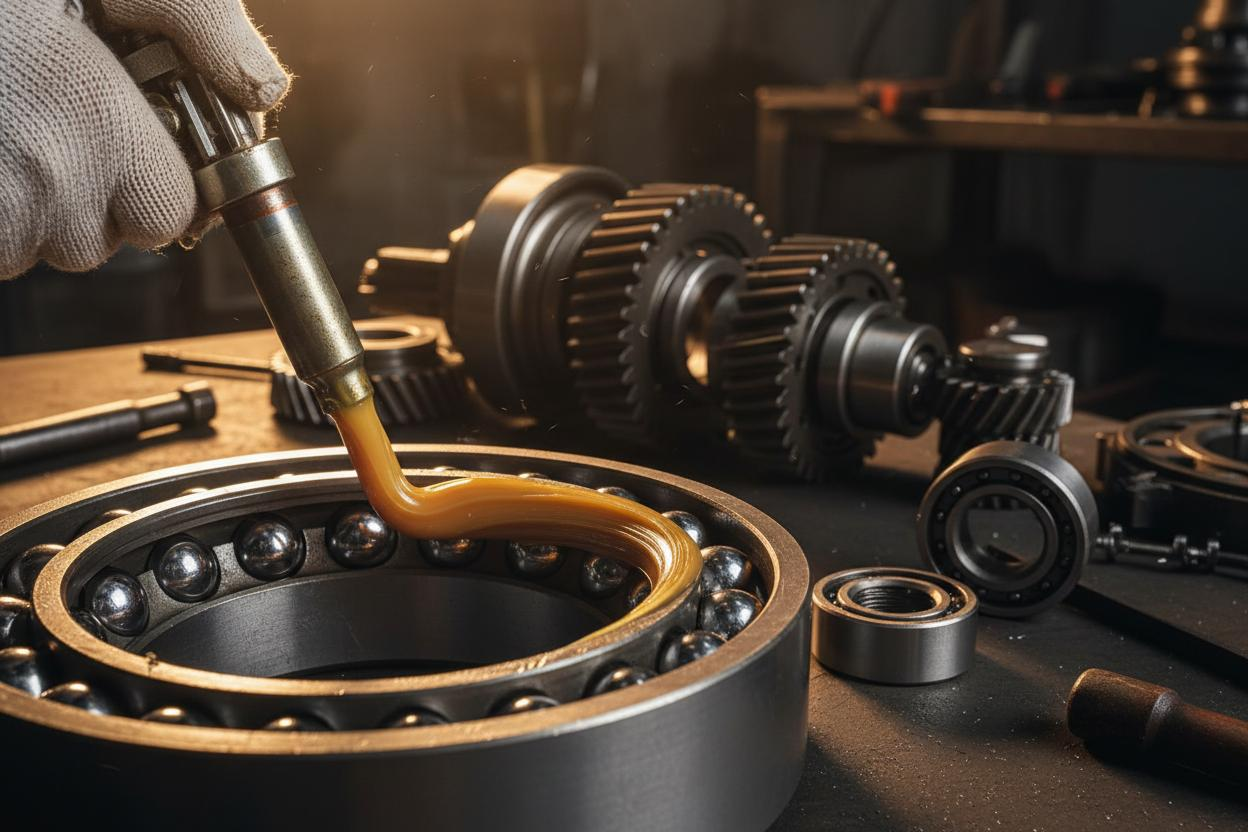
Bearing Grease Selection Guide: How to Choose the Right Grease for Bearings
Bearing grease is one of the most important factors affecting the reliability and service life of rolling bearings. The right grease can help reduce friction and wear, protect bearing surfaces, control operating temperatures, and maintain reliable performance under demanding operating conditions.
However, choosing a bearing grease is not simply a matter of selecting a general-purpose product. Different bearings operate under different combinations of speed, load, temperature, environment, and operating conditions. A grease that performs well in a low-speed, moderate-load application may not be suitable for a high-speed spindle or a high-temperature industrial bearing.
This Bearing Grease Selection Guide explains the key factors to consider when selecting a grease and provides a practical framework for choosing the right lubrication solution.
1. What Is Bearing Grease?
Bearing grease is a semi-solid lubricant generally composed of a base oil, thickener, and performance additives.
The base oil provides the primary lubricating film, while the thickener gives the grease its semi-solid structure and helps keep the lubricant in the bearing. Additives can provide additional properties such as oxidation resistance, corrosion protection, anti-wear performance, or extreme-pressure protection.
For rolling bearings, grease is widely used because it can remain in the lubrication area and provide relatively simple lubrication and maintenance compared with circulating oil systems.
2. Consider Bearing Operating Speed
Bearing speed is one of the most important factors in grease selection.
High-speed bearings can generate significant frictional heat. If the grease has unsuitable characteristics, excessive churning or lubricant resistance can increase bearing temperature and shorten grease life.
For high-speed applications, consider:
- Bearing rotational speed
- Bearing size
- Speed factor
- Base oil viscosity
- Grease consistency
- Thickener type
- Operating temperature
- Grease channeling characteristics
SKF's bearing guidance uses speed, temperature and load ranges as primary parameters for selecting a suitable grease.
For example, high-speed electric motor bearings, machine-tool spindles, fans and precision equipment may require a grease specifically formulated for high-speed operation rather than a conventional multipurpose grease.
3. Consider Operating Temperature
Temperature has a direct influence on grease performance and service life.
A bearing operating at elevated temperatures may require a grease with:
- High thermal stability
- Good oxidation resistance
- Suitable base oil viscosity
- Appropriate thickener technology
- Low evaporation or volatility
- Long service life at operating temperature
For low-temperature applications, the grease should maintain suitable mobility and lubrication performance during cold starts.
Therefore, bearing grease should be selected according to the actual bearing operating temperature, rather than simply looking at the grease's maximum temperature listed on a product label.
For demanding applications, synthetic or specialty greases may provide advantages over conventional mineral-oil-based products.
4. Consider Bearing Load
Bearing load affects the required lubricating film and grease performance.
Heavy-load or shock-load applications may require a grease with:
- Higher base oil viscosity
- Strong film-forming capability
- Good anti-wear performance
- EP performance where appropriate
- Mechanical stability
- Resistance to vibration and shock
Examples include:
- Heavy industrial machinery
- Conveyors
- Mining equipment
- Steel processing equipment
- Construction machinery
- Low-speed, high-load bearings
Timken likewise recommends matching grease formulation to operating conditions such as load, speed, temperature and environmental exposure.
5. Select the Appropriate NLGI Grade
NLGI grade describes the consistency or stiffness of grease.
For rolling bearings, NLGI 1, 2 and 3 are commonly encountered, with NLGI 2 being a widely used consistency for general bearing applications. SKF identifies NLGI consistency as an important grease characteristic for rolling bearings.
However, NLGI grade should not be used alone to select a bearing grease.
A complete selection should also consider:
- Base oil viscosity
- Operating temperature
- Bearing speed
- Load
- Thickener type
- Grease compatibility
- Lubrication method
A higher NLGI number does not automatically mean better bearing protection.
6. Check Base Oil Viscosity
Base oil viscosity is a critical parameter in bearing grease selection.
The appropriate viscosity depends on factors such as:
- Bearing speed
- Bearing load
- Operating temperature
- Bearing size
- Required lubricating film thickness
In general, higher-viscosity base oils can be useful in applications involving higher loads or lower speeds, while lower-viscosity oils may be more suitable for certain high-speed applications.
This is why two greases with the same NLGI grade can have very different performance characteristics.
For example, a grease may be NLGI 2, but its base oil viscosity and formulation can make it suitable for completely different applications.
7. Consider the Bearing Type
Different bearing designs may have different lubrication requirements.
Common applications include:
Deep Groove Ball Bearings
Often require greases with good low-friction and high-speed performance.
Angular Contact Bearings
May require grease formulated for higher-speed operation and specific preload conditions.
Cylindrical Roller Bearings
May require suitable film-forming properties, especially under higher loads.
Spherical Roller Bearings
Often operate under higher loads and may require robust grease performance.
Tapered Roller Bearings
Grease selection should consider load, speed and temperature.
Ceramic or Hybrid Bearings
Special consideration may be required because of their high-speed and low-friction characteristics.
Therefore, always consider the bearing design together with the operating conditions.
8. Consider the Operating Environment
The environment surrounding a bearing can significantly affect grease selection.
Water and Moisture
For wet environments, consider:
- Water resistance
- Corrosion protection
- Mechanical stability
- Resistance to water washout
Dust and Contamination
For dusty or contaminated environments, grease retention and sealing conditions become particularly important.
Chemicals
Chemical-processing equipment may require chemically resistant lubricants. PFPE-based greases, for example, are often considered for applications requiring high chemical resistance and broad temperature capability.
Vacuum
Vacuum equipment may require lubricants with suitable low vapor pressure and low volatility.
Cleanroom and Semiconductor Applications
Specialty lubricants may be required where contamination, outgassing and chemical compatibility are critical.
9. Choose the Right Grease Base Oil
Bearing greases can use different types of base oils.
Mineral Oil
A common choice for general industrial applications where operating conditions are moderate.
PAO Synthetic Oil
PAO-based greases can provide improved low-temperature and high-temperature performance compared with many conventional mineral-oil-based formulations.
Ester-Based Oil
Ester formulations may be suitable for selected high-speed, high-temperature or specialty applications.
Silicone Oil
Silicone-based greases are used in applications requiring particular temperature characteristics or compatibility properties.
PFPE
PFPE lubricants are specialty materials known for chemical inertness, low volatility, non-flammability and broad temperature capabilities. They can be considered for demanding applications such as vacuum equipment, semiconductor manufacturing, oxygen-related service and chemically aggressive environments.
10. Consider Thickener Type
The thickener is another important component of bearing grease.
Common thickener systems include:
- Lithium
- Lithium complex
- Polyurea
- Calcium sulfonate complex
- Aluminum complex
- PTFE
Each thickener system can provide different combinations of:
- Temperature resistance
- Water resistance
- Mechanical stability
- Pumpability
- Compatibility
- Load-carrying performance
For this reason, grease should not be selected solely according to its thickener type. The complete formulation and application conditions must be considered.
11. Check Grease Compatibility Before Changing Products
Do not automatically mix two different bearing greases.
Different greases can use incompatible thickener systems or additive packages. Mixing incompatible greases may result in changes to:
- Consistency
- Oil separation
- Mechanical stability
- Temperature performance
- Lubrication performance
Before changing from one grease to another, check the manufacturer's compatibility information and, when necessary, completely remove the previous grease before introducing the new lubricant.
12. Avoid Over-Greasing
More grease does not necessarily mean better lubrication.
Excessive grease can increase churning and friction, which may raise bearing operating temperature. This can reduce lubricant life and potentially affect bearing reliability.
The appropriate grease quantity depends on factors including:
- Bearing size
- Bearing speed
- Housing design
- Free space
- Operating temperature
- Lubrication method
Timken provides engineering tools specifically for calculating initial grease fill and relubrication quantity/frequency, demonstrating that grease quantity is application-dependent.
13. Determine the Right Relubrication Interval
Bearing grease does not last indefinitely.
Relubrication intervals depend on:
- Bearing type
- Bearing size
- Speed
- Load
- Operating temperature
- Grease type
- Environmental conditions
- Sealing
- Contamination
- Vibration
High-speed or high-temperature applications may require more frequent attention than bearings operating under moderate conditions.
Instead of using a fixed interval for every application, develop a lubrication schedule based on the actual operating conditions and bearing manufacturer's recommendations.
Bearing Grease Selection Checklist
Before selecting a grease, collect the following information:
| Selection Factor | Information to Check |
|---|---|
| Bearing type | Ball, roller, thrust, ceramic, etc. |
| Bearing size | Bore, outside diameter, width |
| Speed | RPM / speed factor |
| Load | Radial, axial, shock load |
| Temperature | Minimum, normal and maximum |
| Environment | Water, dust, chemicals, vacuum |
| Base oil | Mineral, PAO, ester, silicone, PFPE |
| Viscosity | Base oil viscosity |
| NLGI | Required consistency |
| Thickener | Lithium, polyurea, calcium sulfonate, PTFE, etc. |
| Compatibility | Existing grease and seals |
| Lubrication method | Manual, automatic, lifetime fill |
| Relubrication | Quantity and interval |
How to Choose the Right Bearing Grease
A practical selection process can be summarized as:
1. Identify the bearing type
↓
2. Determine speed and speed factor
↓
3. Determine load and operating temperature
↓
4. Evaluate water, dust, chemicals and other environmental conditions
↓
5. Select suitable base oil viscosity
↓
6. Select grease thickener and NLGI grade
↓
7. Check grease and seal compatibility
↓
8. Determine grease quantity and relubrication interval
↓
9. Validate the selected grease under actual operating conditions
This approach is more reliable than choosing a grease simply because it is labeled “multipurpose” or “high temperature.”
Choosing Specialty Bearing Grease for Demanding Applications
For standard industrial applications, conventional lithium, lithium-complex or polyurea greases may be suitable depending on the operating conditions.
For more demanding applications, however, specialty lubricants may offer additional performance advantages.
Depending on the application, consider:
- High-temperature bearing grease
- High-speed bearing grease
- Low-temperature bearing grease
- Heavy-load bearing grease
- Water-resistant bearing grease
- Food-grade bearing grease
- Vacuum bearing grease
- PFPE bearing grease
- Cleanroom-compatible bearing grease
- Chemically resistant bearing grease
For customers operating high-value or critical machinery, the right lubricant should be selected based on the complete operating profile rather than a single specification.
Final Thoughts
Selecting the right bearing grease requires more than comparing product names or NLGI grades. Speed, load, temperature, base oil viscosity, bearing type, thickener, environment and relubrication requirements all influence the final selection.
A systematic selection process can help reduce lubrication-related failures, improve bearing reliability and support longer maintenance intervals.
For specialized applications, consult the lubricant manufacturer's technical data and the bearing manufacturer's recommendations before making a final selection. Timken, for example, provides application-specific grease selection tools, while SKF's bearing guidance uses operating speed, temperature and load as key selection parameters.
Need help selecting a bearing grease? Provide your bearing model, operating speed, load, temperature and application environment, and a suitable lubricant can be evaluated based on the actual operating conditions.
NLGI Grade for Bearing Grease Explained: How to Choose the Right Consistency


